Recovery

AURA's Recovery Subteam.

The Recovery subteam designs and manufactures the systems that bring the rocket safely back to the ground after launch. Recovery's work covers a range of systems, including parachutes, stage separation, and Barometric Avionics Enclosures (BAEs). The team's work spans CAD design, 3D printing, parachute sewing, Python scripting, and pyrotechnic testing. From apogee to touchdown, Recovery brings the vehicle home.

Barometric Avionics Enclosure (BAE)

The Barometric Avionics Enclosure (BAE) houses the rocket's avionics and ejection charges. It is housed inside a coupler at the separation point between two airframe sections.

Design

The BAE is designed using CAD software such as SolidWorks. It houses the altimeters, batteries, and arming switches, which are accessible from the outside of the rocket for pre-flight activation. At each end of the enclosure, charge cups and e-matches sit on top of a bulkhead that shields the avionics from the ejection charges. When the altimeters detect apogee or proper altitude, the e-matches fire, increasing pressure in the body tubes and separating the rocket.

Manufacturing

The BAE is built around a 3D-printed altimeter bracket sandwiched between two bulkheads, with 3D-printed charge cups mounted on each end. The bracket holds the avionics in place while the bulkheads seal off the charge wells, containing the pressure that separates the rocket.
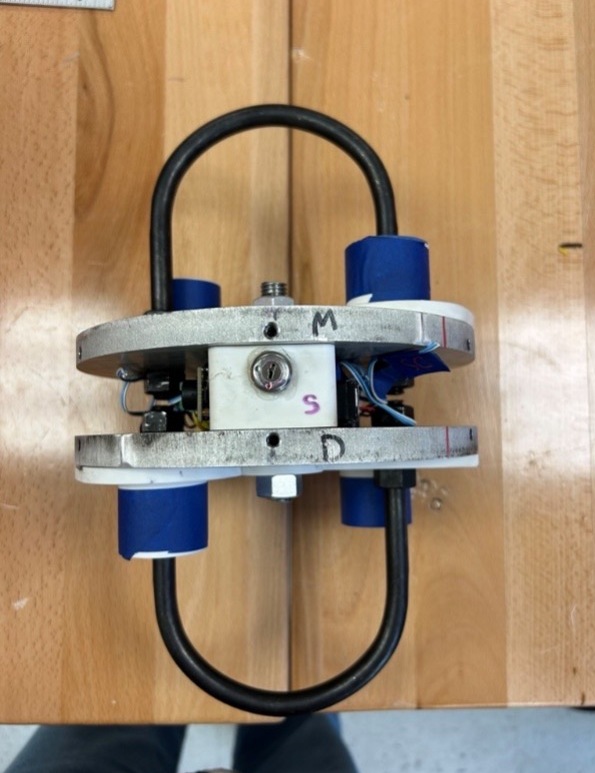
Barometric Avionics Enclosure assembly

Parachute

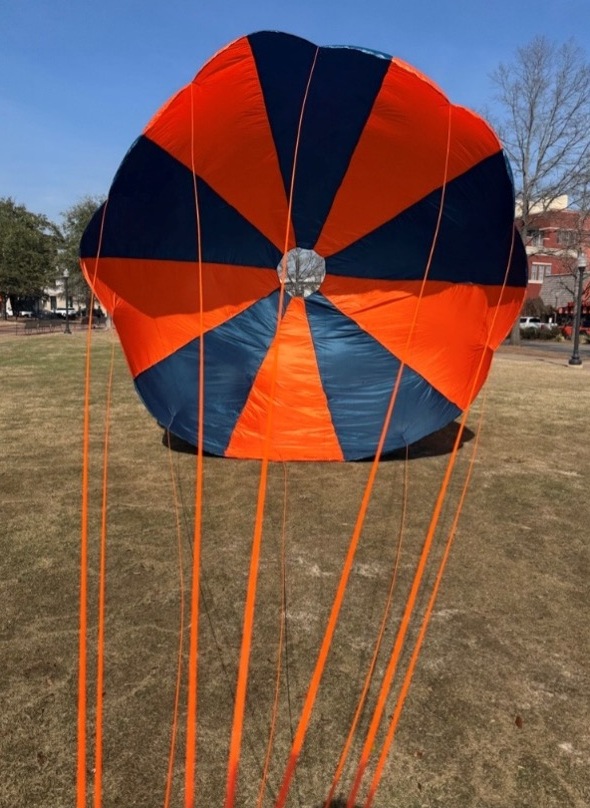
Our parachutes consist of a nylon canopy and paracord shroud lines. They create a large drag force, slowing our vehicles to a safe terminal velocity before landing.

Design

AURA uses two main parachute shapes: circular and hemispherical. Each shape has a different drag coefficient, which determines how much drag force the parachute generates for a given reference area. Circular parachutes have a drag coefficient around 0.8, while hemispherical chutes are closer to 1.5. From the target descent rate, vehicle mass, and drag coefficient, the team calculates the required diameter, then generates a gore pattern using a Python script.

Manufacturing

Each gore is cut from 1.1 oz calendered ripstop nylon and sewn together with a French seam using both an overlock and a straight stitch. The parachute is then hemmed, and the paracord shroud lines are attached, untangled, and tied off.

Parachute Harness

The parachute harness is made of tubular nylon, offering a great strength-to-weight ratio. This keeps the rocket together after parachute ejection and ensures the components don't collide with each other during descent.

AURA orange and navy parachute deployed on the field

Ejection Testing

Before flight, the team performs ground ejection testing to confirm the rocket will separate cleanly. The required black powder charge is calculated, loaded into the charge cups, and the rocket is laid on its side. The e-matches are connected to a pyrotechnic controller so that they can be fired from a safe distance. From here, charge amounts are adjusted as needed to successfully break the shear pins and reliably separate the rocket.